
Overview:
In 2015, an established software platform was acquired by an international organisation.
While the application itself was functional, it had been built on infrastructure that was not
designed to scale or integrate with external systems. Echo Media was engaged to design
and implement a modern cloud infrastructure that would support immediate growth, enable
software expansion, and allow the platform to integrate with wider enterprise systems over
time.
The Challenge:
The core system began life as a relatively simple CRM, running on legacy infrastructure with
limited scalability and no clear separation between application logic, data, or external
access. As part of the acquisition process, the platform needed to:
● Scale reliably to support increased usage
● Support new public-facing applications
● Allow secure integration with remote and third-party systems
● Prepare for eventual connection to a larger international technology ecosystem
The existing infrastructure could not meet these requirements without a fundamental
redesign.
limited scalability and no clear separation between application logic, data, or external
access. As part of the acquisition process, the platform needed to:
● Scale reliably to support increased usage
● Support new public-facing applications
● Allow secure integration with remote and third-party systems
● Prepare for eventual connection to a larger international technology ecosystem
The existing infrastructure could not meet these requirements without a fundamental
redesign.
The Solution
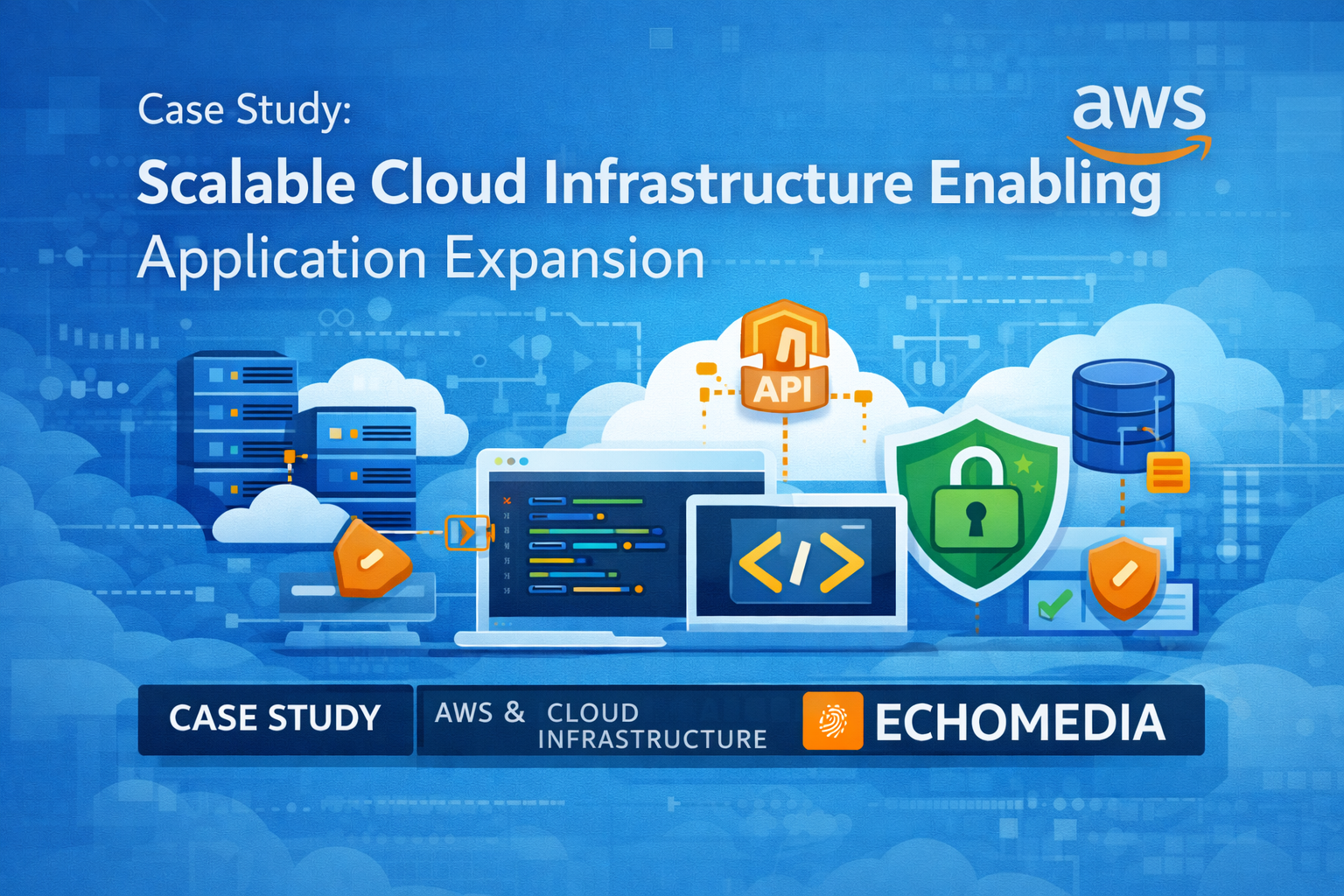
Echo Media designed and delivered a cloud-native AWS infrastructure that allowed the
application to expand safely and predictably. Rather than treating infrastructure as a hosting
layer, the platform was re-architected so that infrastructure actively enabled future software
development.
A key part of this work was the introduction of a dedicated API layer, allowing all
transactions and data access to flow through controlled, secure endpoints. This decoupled
the CRM from direct front-end usage and enabled the development of additional applications
without compromising the core system.
application to expand safely and predictably. Rather than treating infrastructure as a hosting
layer, the platform was re-architected so that infrastructure actively enabled future software
development.
A key part of this work was the introduction of a dedicated API layer, allowing all
transactions and data access to flow through controlled, secure endpoints. This decoupled
the CRM from direct front-end usage and enabled the development of additional applications
without compromising the core system.
The infrastructure was designed to support:
● Load-balanced application services
● Secure API-driven access for internal and external consumers
● Independent scaling of application components
● Load-balanced application services
● Secure API-driven access for internal and external consumers
● Independent scaling of application components
● Long-term integration with external enterprise systems
AWS Services Utilised:
While the exact configuration evolved over time, the project made use of AWS services
typically associated with scalable, production-grade platforms, including:
● Amazon Web Services EC2 – application compute
● Elastic Load Balancing (ALB) – traffic distribution and high availability
● Auto Scaling Groups – dynamic scaling based on demand
● Amazon RDS – managed relational database services
● Amazon S3 – asset storage and backups
● Amazon VPC – secure network isolation
● IAM – access control and permissions
● CloudWatch – monitoring, logging, and alerting
● Route 53 – DNS and traffic routing
● API Gateway – controlled API access for applications and integrations
Implementation Highlights
● Migration from legacy infrastructure to a resilient AWS environment
● Introduction of an API-first architecture to support expansion
● Separation of concerns between application, data, and access layers
● Infrastructure designed to support both public-facing apps and remote system
integrations
The Outcome
The new AWS infrastructure transformed the platform from a single-purpose CRM into a
scalable foundation capable of supporting multiple applications and integrations.
Public-facing web applications were developed on top of the API, while remote systems
were able to integrate securely without direct database access.
Most importantly, the infrastructure enabled the acquiring organisation to progressively
connect the platform to its wider international systems, without requiring disruptive rework.
What began as an infrastructure project became a key enabler of long-term product and
business growth.
Ongoing Evolution
Following the initial infrastructure build, the platform continued to evolve — with new
applications, integrations, and features added over time — all supported by the underlying
cloud architecture put in place at the start of the acquisition process.
cloud architecture put in place at the start of the acquisition process.

